

Socks are an indispensable clothing item in people's daily life, and the mass production of socks is inseparable from the efficient operation of sock machines. From traditional mechanical sock machines to modern computer sock machines, technological innovation has greatly improved the efficiency and diversity of sock production. So, how do sock machines work?
Content
Basic structure of sock machines
Workflow of sock machines
Working characteristics of different types of sock machines
Maintenance and care of sock machines
Basic structure of sock machines
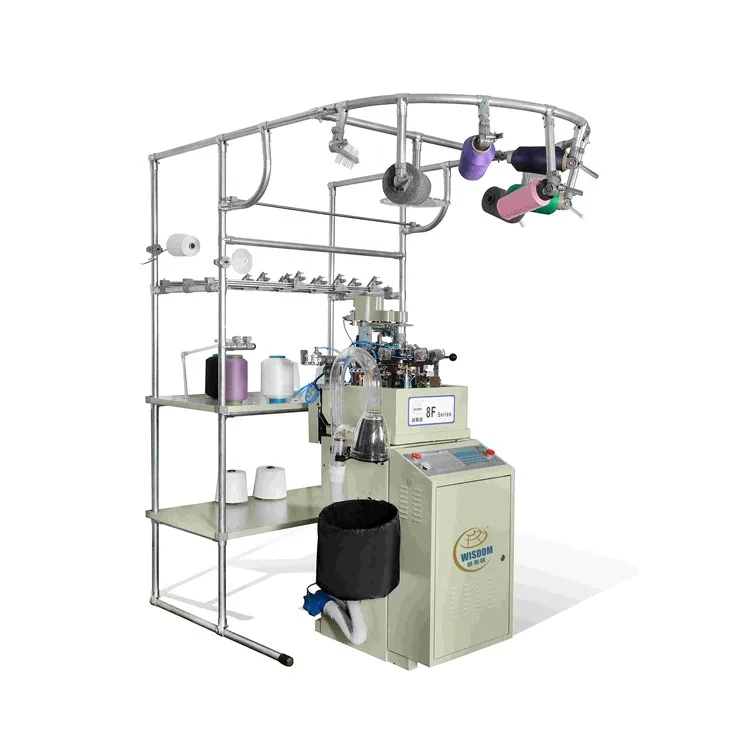
The sock machine is mainly composed of a yarn feeding system, a knitting mechanism, a transmission system, a control system and auxiliary devices. These parts work together to complete the entire processing process from yarn to socks.
The yarn feeding system is the "raw material delivery station" of the sock machine, which is composed of yarn tubes, yarn guides, tensioners and other components. The yarn tube is used to place the wound yarn, and the yarn guide is like a "navigator" to accurately guide the yarn to the knitting area. The role of the tensioner is crucial. It can adjust the tension of the yarn to ensure that the yarn will not be too loose to cause the coil to loosen during the knitting process, nor will it be too tight to cause the yarn to break, providing a stable yarn supply for subsequent knitting.
The knitting mechanism is the core part of the sock machine, which is equivalent to a "production workshop" and includes key components such as needle cylinders, knitting needles, and sinkers. The needle cylinder is a cylindrical component with dense needle grooves on its surface, and the knitting needles are installed in these needle grooves. There are many types of knitting needles, the most common of which are latch needles and hook needles. They move regularly under the drive of the needle cylinder, and complete the knitting of socks by hooking the yarn and forming a coil. The sinker is located between the knitting needles and plays an auxiliary role in the knitting process, helping to fix the coil, control the coil size, and ensure the stability of knitting.


The transmission system provides power for the operation of the sock machine. Traditional sock machines usually use mechanical transmission, and transmit the power of the motor to each working mechanism through gears, belts and other components to drive the needle cylinder to rotate and the knitting needle to move. Modern computer sock machines use servo motor transmission more often, which can more accurately control the movement speed and position of each component and improve the knitting accuracy.
The control system is the "brain" of the sock machine, responsible for coordinating the work of various parts. The control of traditional sock machines mainly relies on mechanical cams, which control the movement trajectory of the knitting needles through the contour curve of the cam, so as to weave specific patterns and styles. Modern computer sock machines are equipped with microprocessors and corresponding control software. Operators can input parameters such as sock styles, patterns, and sizes through programming. The control system will accurately control the movements of each component based on these parameters to achieve automated production.
Auxiliary devices include pulling mechanisms, winding mechanisms, and yarn breakage self-stop devices. The pulling mechanism applies a certain pulling force to the fabric during the weaving process, so that the knitted socks can be smoothly detached from the needle cylinder to ensure the continuity of weaving. The winding mechanism winds and organizes the knitted socks for subsequent processing and transportation. The yarn breakage self-stop device is a protective device. When the yarn breaks or other faults occur, it can detect and stop the sock machine automatically in time to avoid defective products caused by faults, and also protect the machine equipment.
Workflow of sock machines
The workflow of sock machines can be roughly divided into yarn feeding, weaving, pulling, winding, etc., and each link cooperates closely to complete the production of socks.

In the yarn feeding link, the yarn is drawn out from the yarn tube, guided by the yarn guide and adjusted by the tension of the tensioner, and then transported to the working area of the weaving mechanism. The adjustment of the tensioner is crucial. It can control the yarn tension within a suitable range according to the type, thickness and knitting process requirements of the yarn, ensuring that the yarn can smoothly enter the knitting process.
The knitting link is the core of the sock machine. When the yarn reaches the knitting area, the needle cylinder begins to rotate, and the knitting needle installed in the needle groove of the needle cylinder moves up and down driven by the transmission system. There is a hook at one end of the knitting needle. When the knitting needle rises, the hook will hook the yarn; as the knitting needle descends, the hook will bend the yarn and pass through the previously formed coil to form a new coil. Through the interconnection of countless coils, the fabric structure of the socks is gradually formed. When knitting different parts, such as the toe, heel, and tube, the movement law of the knitting needle will change to adapt to the shape and size requirements of different parts. For example, when knitting the heel, some knitting needles will stop working, and the curvature of the heel will be formed by the retraction and expansion of the coil.
The pulling mechanism starts working while knitting, and it applies continuous and uniform pulling force to the knitted socks. This pulling force can keep the newly formed coils at a certain size and tension, avoid the coils being too loose or too tight, and ensure the size of the socks is stable. At the same time, the pulling action can also pull the knitted part off the needle cylinder, making room for subsequent knitting, so that the knitting process can be carried out continuously.
When the socks are knitted to a certain length, the winding mechanism will wind the knitted socks on the cloth roller. The winding speed will be adjusted according to the knitting speed to ensure that the winding process is synchronized with the knitting process, so that the socks can be neatly wound, which is convenient for subsequent cutting, sewing, shaping and other processing links.
Working characteristics of different types of sock machines
According to different knitting methods, sock machines can be divided into circular sock machines and flat sock machines, which have certain differences in working characteristics and scope of application.
Circular sock machines are currently the most widely used type of sock machines, and the socks they knit are in the shape of a cylinder. The needle cylinder of the circular sock machine is circular, and the knitting needles are arranged along the circumference of the needle cylinder. When working, the needle cylinder rotates continuously, and the knitting needle moves up and down driven by the needle cylinder. At the same time, the yarn is continuously transported to the knitting area through the yarn feeding system. The knitting needle hooks the yarn and forms a coil, and the coils are interlaced to form a cylindrical sock fabric. The circular sock machine has a high production efficiency and is suitable for mass production of various styles of socks, such as short socks, long socks, sports socks, etc. In addition, modern computer circular sock machines can also realize complex pattern knitting through programming to meet diverse market needs.
The flat sock machine knits a sheet of socks, which needs to be sewn to form socks. The knitting mechanism of the flat sock machine is flat, and the knitting needles are arranged on both sides of the flat plate. When working, the knitting needles reciprocate on the flat plate, and the yarn forms a sheet of fabric under the action of the knitting needles. Because the knitting is sheet-shaped, the flat sock machine has certain advantages in knitting some special styles of socks, such as five-finger socks and socks with complex patterns, and can more accurately control the shape and pattern of the fabric. But relatively speaking, the flat sock machine has a low production efficiency and is more suitable for small-batch and personalized sock production.
Maintenance and care of sock machines
In order to ensure the normal operation of sock machines and extend their service life, daily maintenance and care are essential.
It is necessary to clean the various components of the sock machine regularly, remove dust, yarn debris and other debris on the surface and inside of the machine, and prevent these debris from entering the machine and affecting the normal movement of the components. Especially for the knitting mechanism and transmission system, if too much debris accumulates, it may cause problems such as needle jamming and gear wear.
It is necessary to check the lubrication of each component regularly, add an appropriate amount of lubricating oil to the transmission parts, bearings and other easily worn parts, ensure good lubrication between parts, reduce friction and wear, and improve the operation efficiency of the machine. At the same time, pay attention to the type and amount of lubricating oil to avoid damage to the machine due to improper use.
It is also necessary to regularly check the integrity of vulnerable parts such as knitting needles and sinkers. If there are problems such as wear, bending, and breakage, they should be replaced in time to avoid affecting the knitting quality. In addition, for the control system, software updates and parameter calibration should be carried out regularly to ensure its control accuracy and stability.
In short, the sock machine transforms yarn into a variety of socks through the collaborative work of various systems. With the continuous advancement of science and technology, the performance of sock machines has been continuously improved, and they are developing in the direction of automation, intelligence, and efficiency, providing strong technical support for the development of the sock manufacturing industry.


