

1. Conduct Market Research
In today's market, price is no longer the only factor influencing consumer purchases. While it still matters, factors like brand differentiation, customer experiences, and reputation play an equally significant role in driving sales.
Conducting market research is key to understanding both your customers and the industry, giving you a better shot at success.
Start with secondary research by analyzing available market data. For the sock industry, focus on gathering key insights such as:
The average price range for different types of socks
Typical profit margins for sock businesses
The best-selling sock styles
The most effective platforms for selling socks
This data will help you spot gaps in the market, enabling you to stand out from competitors. Additionally, it will reveal trends-such as this year's top-selling socks-that can guide your product offerings to align with consumer preferences.
Next, take a deep dive into your competitors. Analyze top players in the sock industry to learn what works. Online platforms like eBay provide valuable data to track competitors' sales trends.
Here are some important areas to explore:
The types of socks your competitors are offering
Their sales volumes and pricing strategies
An estimate of their profit margins
Their advertising and promotional methods
Their approach to customer service
Success leaves clues. By studying industry leaders, you can identify best practices and avoid common pitfalls.


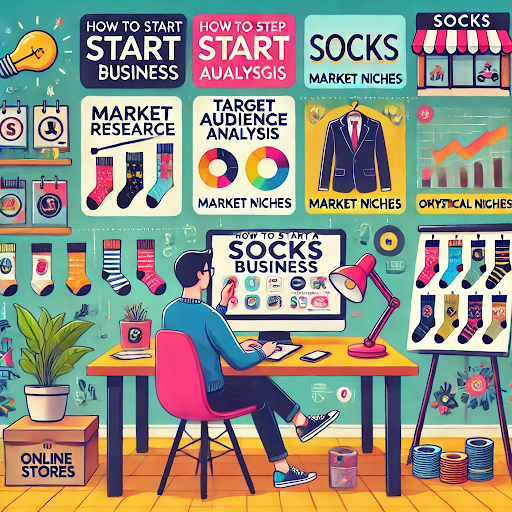
2. Identify Your Target Audience and Market Niche
As a small upstart e-commerce business, it's hard to attract everyone. Instead, it's better to niche your store to attract a niche audience. This helps you stand out among competitors and makes your brand the go-to option for a specific niche.
91% of consumers believe they're more likely to shop with brands that provide relevant offers. For example, creating only socks with pet graphics attracts pet lovers who obsess over anything revolving around animals.
When picking your niche, it's best to look for underserved markets that other sock businesses neglect. For example, maybe you've found that toddlers need non-slip socks or patients need compression socks.
You can also browse on Etsy to get an idea of what types of socks are selling. Pick a niche that resonates with your passions and has a high demand.
Once you know the market you want to sell to, start conducting primary research to learn more.
For example, perform surveys on customer preferences. See what types of socks your potential customers would like and their preferred colors and fabrics. Also, look through all the positive and negative customer reviews from other businesses. What are customers in this niche complaining about? Can you win them over with faster delivery, better quality socks, better packaging, or lower costs?
3. Establish the Type of Socks You Want to Make
Now that you know what your customers want and what niche you want to enter, you can decide on the type of socks to sell.
You'll want to choose the sock types, designs, fabrics, decorative patterns, branding styles, and colors based on your research.
Before you choose your type, we recommend looking at the types of socks that sell best. For example, if you type in "socks" on the Etsy search bar, you'll get recommendations such as:
Socks with faces
Socks monkey
Wool socks
Women's patterned socks
As a beginner, it's better to sell trendy styles of socks. If you go with an obscure sock type, you risk drawing little interest. Make a list of the types of socks you want to sell, then narrow the list based on your passion for them and whether you can find a manufacturer to make them for you.


4. Build Your Brand
With your product finalized, it's time to focus on building your brand. Your brand is more than just visuals like logos, website design, or color schemes-it's the entire perception customers have of your business. This includes your mission, values, and tone of voice, all of which should resonate with your target audience.
Define Your Brand Position
Start by determining your brand position, which defines how you want to be perceived in the market. Remember, you can't be everything to everyone-for example, you can't position yourself as both a luxury socks brand and a budget-friendly option. Craft a brand positioning statement that clearly communicates who you are and what you do. For instance: "We are a premium sock company offering warm, durable wool socks designed for outdoor enthusiasts."
Create Visual and Verbal Identity
Once your position is clear, focus on building the visual and verbal elements that support it. Ensure your logo, website, packaging, and social media reflect your brand identity. A cohesive look and tone will strengthen your connection with customers.
Consistency is key-apply your brand elements across every touchpoint, from your website and ads to your packaging and emails..


5. Decide Where to Sell Your Socks
Today's e-commerce landscape offers a variety of platforms for selling your products, each with its own strengths. The two primary options are creating your own online store or selling through third-party marketplaces.
Selling Through Your Own Online Store
Building your own e-commerce store gives you full control over the customer experience. While it requires effort to drive traffic, it offers several benefits
Full control over your brand: You can fully customize your store to align with your branding. Many platforms offer templates that can be tailored with elements like chatbots or email collection forms to engage visitors
Retargeting Opportunities: Unlike marketplaces, owning your store lets you retarget shoppers through ads, helping you build loyalty and increase conversions.
Email list Growth: Your store allows you to collect emails, enabling you to build a direct customer base. Marketplaces typically don't provide access to customer data.
Marketplaces are great for quickly starting sales without the need for a dedicated website. Examples of marketplaces include eBay, Etsy, and Amazon Handmade.
Here's why marketplaces can be advantageous:
Both approaches have unique advantages, so consider a strategy that combines the benefits of each. For example, launch on marketplaces to gain early traction while gradually building your own branded store for long-term growth.
Ease of Setup: You don't need to build a site from scratch; simply create product listings within existing categories.
High Traffic Volume: These platforms attract millions of buyers who already trust the marketplace. Consumer protection policies make them comfortable purchasing from new sellers.
Immediate Sales Potential: With well-optimized listings, you can start making sales almost immediately.

6. Pricing Your Socks
Pricing your socks can be a game of art and science. There's no exact formula. Setting your price too high causes shoppers to abandon their carts, while aiming too low means you miss out on untapped profits.
The pricing strategy you choose depends on your product. If you sell premium socks, you may consider value–based pricing, meaning you set a price based on how much customers think your products are worth.
Sometimes, pricing higher than competitors is a smart move, especially if you offer something they don't. Value-based pricing works for sellers with differentiating qualities, such as sustainability or better materials. In fact, 34% of people are willing to pay more for sustainable products.
If you sell the same product to customers with little differentiation, you may go with a competitor pricing strategy. This is where you charge less than other stores. However, you could be left with charging too low and fall victim to being in a race to the bottom.

7. Find a Wholesale Socks Supplier
Now, you're ready to find a print-on-demand supplier who can meet your demands, such as design, sizes, shipping times, and costs.
We suggest going to a supplier who can offer custom services. For example, THE/STUDIO allows you to fully customize your socks. You can choose from a wide range of sock types, such as no-show, crew, quarter, and knee-high socks. Nearly anything you can imagine, THE/STUDIO can do.
From retail packaging to fabrics and everything in between, THE/STUDIO helps you craft the perfect custom socks for your customers. You can upload your own artwork or have one of our in-house designers help you.
8. Develop a Marketing and Promotion Plan
If you've decided to create an online store, you'll need a marketing strategy to drive traffic to your website.


