

There are many ways to improve the quality of sock knitting. Here are some effective methods:
- Optimize yarn quality and management
- Precisely control yarn tension
- Reasonably set knitting process parameters
- Do a good job of equipment maintenance and debugging
- Improve production environment
- Strengthen control system management
- Establish quality inspection system
1. Optimize yarn quality and management
Choose yarn with good quality, uniform thickness, high strength and appropriate twist. Before putting it into production, conduct strict quality inspection on the yarn, including yarn linear density deviation, strength coefficient of variation and other indicators. Store the yarn reasonably, keep the temperature and humidity of the storage environment suitable, and avoid the yarn from getting damp, moldy or contaminated. Before the yarn is put online, carry out necessary cleaning and sorting to remove impurities and hairiness on the surface of the yarn.
2. Precisely control yarn tension
Install a high-precision yarn tensioner and accurately adjust the tension according to different yarn types and knitting requirements. Ensure that the tension of each yarn is consistent, which can be monitored and adjusted in real time through the tension sensor. During the knitting process, check the yarn tension regularly to detect and solve the tension fluctuation problem in time.
3. Reasonably set the knitting process parameters
According to the style, material and customer requirements of the socks, select the appropriate knitting speed, needle cylinder speed, yarn bending depth, needle pressure and other parameters. When developing new products or adjusting processes, conduct sufficient experiments and tests to optimize process parameters and ensure stable knitting quality. Establish a process parameter database to record and manage the process parameters of different products for reference and call-up in subsequent production.
4. Do a good job of equipment maintenance and debugging
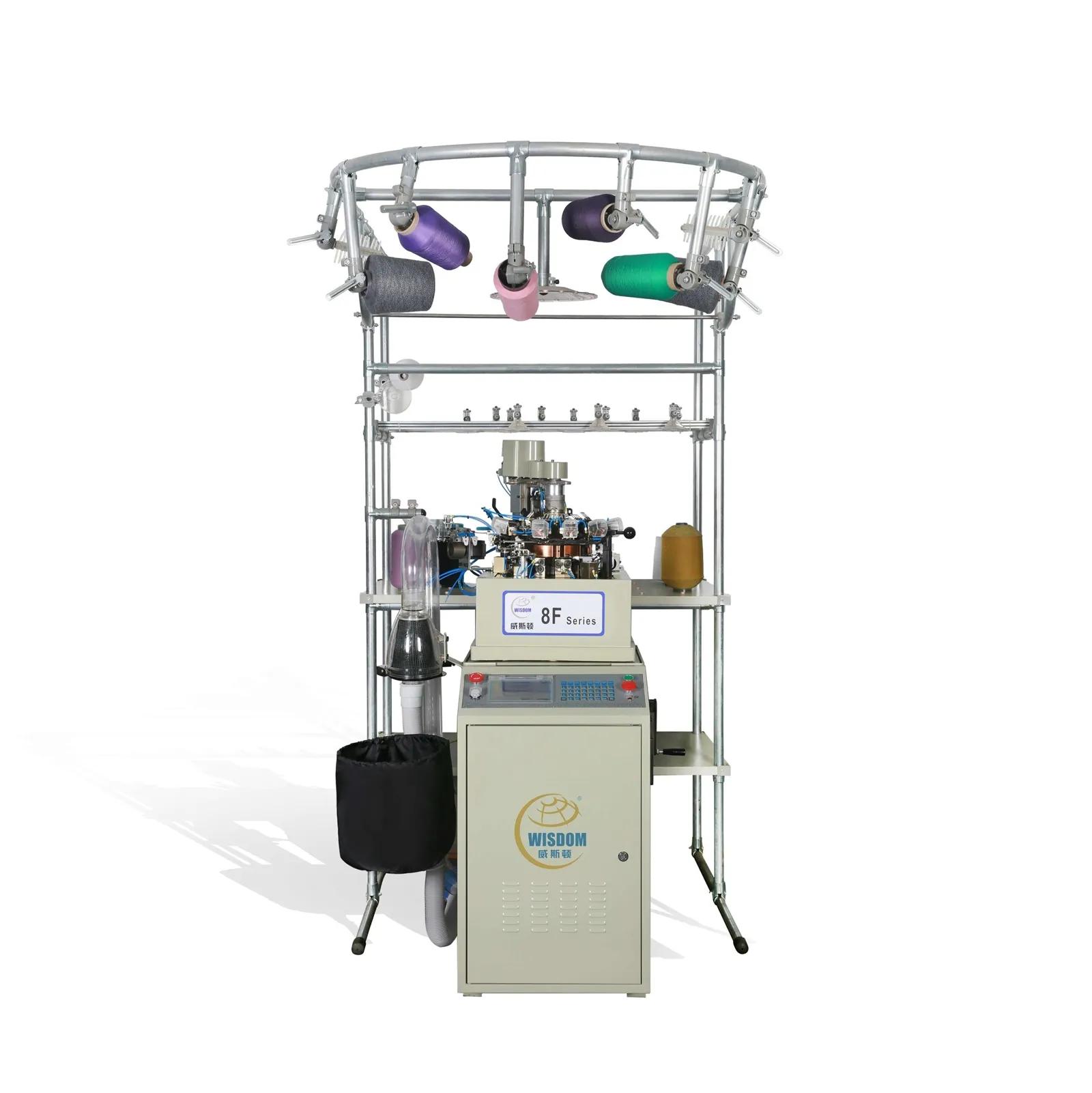
Regularly clean, lubricate and maintain the hosiery machine in a comprehensive manner, including key components such as needle cylinders, knitting needles, yarn guides, and machine head guides. Replace worn or damaged parts in a timely manner to ensure good mechanical properties of the equipment. During the equipment installation and debugging phase, strictly follow the operating procedures to ensure that the equipment installation level and the matching accuracy between components meet the requirements. Regularly calibrate and debug the equipment to ensure accurate needle movement, normal operation of the needle selector, and good synchronization of the upper and lower needle cylinders.
4.1 Key points of single-needle cylinder hosiery machine maintenance
Maintenance of core components
Cylinder cleaning: Use a soft brush and air gun to remove yarn debris in the needle groove every week to prevent needle jam.
Needle detection: Use a laser needle gauge to measure the wear of the needle hook. If it exceeds 0.05mm, it needs to be replaced to avoid missing needles.
Yarn guide calibration: Use a micrometer to adjust the centering of the yarn guide hole and the knitting needle, and the deviation is controlled within ±0.02mm.
Transmission system maintenance
Head rail lubrication: Apply high-temperature grease before each shift to ensure that the sliding resistance is < 5N.
Belt tension detection: Use a tension meter to measure the transmission belt tension every month and keep it within the range of 80-100N to prevent speed fluctuations caused by skipping.
4.2 Maintenance features of computer socks machine
Electronic system maintenance
Calibration of needle selector: Use an oscilloscope to detect the response time of the needle selection electromagnet every month to ensure that it is within 12ms (response delay will cause pattern misalignment).
Moisture-proof treatment of circuit board: Nano-coating is performed on the control board every six months to prevent short-circuit faults caused by workshop humidity (>60%).
Data backup and recovery
Program security: Back up the jacquard program to the cloud every week, and use dual hard disk redundant storage to prevent data loss caused by virus attacks.
Parameter verification: Every time the product is replaced, the verification software is used to compare the current parameters with the standard database, and the deviation items are automatically prompted.
4.3 Special maintenance of high-speed sock machines
Thermal management system
Bearing temperature monitoring: Install an infrared temperature measurement module, and automatically alarm when the bearing temperature exceeds 70℃ (normal operating temperature ≤55℃).
Cooling system maintenance: Clean the radiator fins every month to ensure that the air volume is ≥1200m³/h to prevent thermal deformation caused by high-speed friction.
Dynamic balance adjustment
Needle cylinder dynamic balance correction: Use a dynamic balancing machine to correct the needle cylinder every 2000 hours of operation, and the residual imbalance is ≤5g・cm.
Inertia compensation setting: Enter the needle cylinder mass parameters in the control system, automatically calculate the compensation value, and reduce high-speed vibration.
4.4 Terry sock machine maintenance focus
Special mechanism maintenance
Terry sinker cleaning: Use a copper brush to clean the fluff in the sinker groove every day to avoid affecting the formation of terry (a factory did not clean it in time, resulting in a terry height deviation of more than 0.3mm).
Terry pressing device adjustment: Use a pressure sensor to calibrate the pressing pressure and keep it within the range of 1.2-1.5N to ensure that the terry is evenly lodged.
Yarn delivery optimization
Terry yarn tension control: Use an independent tension controller to control the tension fluctuation within ±5% (±8% for ordinary yarn).
Yarn guide path optimization: Add terry yarn guide porcelain eyes to reduce yarn fluffing caused by friction (a company reduced 28% of broken ends through this measure).
5. Improve the production environment
Control the temperature and humidity of the production workshop, keep the temperature within a suitable range (generally 20℃-25℃), and the relative humidity at around 40%-60% to reduce the fluctuation of yarn performance affected by the environment. Strengthen the cleaning management of the workshop, regularly clean the floor, equipment surface and surrounding environment, and reduce the pollution of dust and impurities to yarn and equipment.
Improve the skill level of operators
Systematic training for operators, including the operating principles of sock machines, maintenance knowledge, common troubleshooting methods, and process parameter adjustment. Regularly organize operators to conduct skill assessments and experience exchanges to encourage operators to continuously improve their operating skills and problem-solving abilities. Establish a quality assessment system for operators, link product quality with the performance of operators, and improve operators' quality awareness and sense of responsibility.
6. Strengthen control system management
For computer-controlled sock machines, control system management is essential to ensure that the production process runs smoothly and efficiently. Regularly update and maintain the control system's software to ensure that the software runs normally and stably. This includes not only installing the latest software patches and security updates to prevent potential software failures and cyber threats, but also optimizing software algorithms to improve knitting accuracy and speed. For example, by fine-tuning the algorithms that control needle movement and yarn feeding, the machine can produce socks with more stable quality and fewer defects.
The Crucial Role of Timely Sensor and Controller Maintenance in Sock Machine Control Systems
Regularly check and maintain the control system's hardware, and replace aging or damaged electronic components such as sensors and controllers in a timely manner. Sensors play a vital role in monitoring various parameters of sock machines, such as yarn tension, needle position, and machine temperature. Sensor failure can lead to inaccurate readings, which in turn can cause knitting errors or even machine failures.
Install an Uninterruptible Power Supply (UPS) to prevent damage to the control system due to power outages or fluctuations. Power outages or voltage spikes can have a serious impact on the sensitive electronic components of the control system, potentially resulting in data loss, software corruption, or hardware damage. The UPS provides temporary power during power outages, allowing the sock machine to continue operating for a short period of time or shut down gracefully without causing any damage to the system. In addition, some advanced UPS systems also provide features such as voltage regulation and surge protection, which can further protect the control system from power-related problems.
7. Establish a quality inspection system
Set up multiple quality inspection points on the sock machine production line to monitor the knitting process of socks in real time, and promptly discover and deal with quality problems. These inspection points should be strategically placed at different stages of the production process, such as before the yarn is fed into the machine, during the knitting process, and after the socks are completed. By conducting regular inspections at these points, quality control personnel can identify any potential issues early on and take corrective actions immediately, preventing the production of defective socks and reducing waste.
Using advanced testing equipment, such as sock appearance testers and size measuring machines, the finished socks are fully inspected for quality to ensure that the products meet quality standards. Sock appearance testers can detect various types of defects, such as holes, stains, and uneven weaving, while size measuring machines can accurately measure the size of the socks to ensure that they meet the specified size requirements. In addition to these basic testing equipment, some modern sock factories also use more advanced technologies, such as computer vision systems and artificial intelligence algorithms, to automate the quality inspection process and improve the accuracy and efficiency of inspections.


